The safety of negative criticism

In a class I took a few years ago, the professor assigned readings every week and instructed the students to come up with some comments or discussion questions in response. The readings were primarily research articles in psychology and neuroscience.

At one point the professor brought to our attention that most of the time our comments were negative and critical. “The researchers could’ve done XYZ but they didn’t” or “You can’t use an ANOVA for these data, can you?” or “They didn’t perfectly control for XYZ so their results are less conclusive.” These comments usually weren’t followed up on with alternate suggestions, so the professor would try to coax them out of people. “How would you have improved on the study?” she’d ask. But what’s more, she wanted a substantive discussion of the bigger picture questions. She started to demand more questions larger in scope and accompanied by people’s own ideas for experiments. The discussion had a different intensity then, more energetic and thought-provoking than when students just sat around picking at other people’s work.

Don’t get me wrong. It’s important to pick apart ideas and recognize a study’s limitations and flaws, whatever they happen to be: abuse of statistics, a poorly chosen subject population, a set of conclusions that’s too bold given the relatively weak results. That’s all a necessary part of critical thinking. Regardless of whether you’re a scientist or not you need to be able to evaluate people’s claims and see what merit they have.

But it’s also important to think in a more positive sense – generating ideas, asking questions, relating one topic to another and considering the implications of different findings. Fewer student comments referred to the strengths of any given study, only the weaknesses.

I remember at the time thinking of why negative remarks naturally dominated our discussions until the professor stepped in:

  • We were afraid to look stupid. If we offered our own ideas they could get shot down and maybe show the workings of an immature mind. What did we know? We didn’t want to take risks. Picking at other people’s mistakes protected us from the most part from criticism, and this was important because we worried too much about what others thought of us.
  • Some of us wanted to look like hotshots in a game of one-upmanship. It was less about the research, more about scoring points off of other people.
  • We were emulating certain professors. The one who ran the class wasn’t like this, but over the years I’ve known other professors who liked to devote their seminars to shredding the work of academic rivals in a mix of scholarly rigor and personal enmity (recently I watched a movie that explores this toxic mix).
  • We were on the receiving end of frequent critical evaluation, sometimes of a very negative kind, so we liked being able to dish it out. It gave us a feeling of power.
  • Making small focused negative remarks took less effort than also trying to think of solutions or come up with new ideas or questions to investigate. Granted, our critical thinking, even if it was mostly negative criticism, took more mental effort than just blindly accepting or rejecting something without justification; we did our homework. But for lack of time, training, knowledge or willingness to put in the effort, we stuck to picking things apart.

One reason I respected the professor who taught that class was her balanced approach to criticizing other people’s work. She looked for flaws, but also for possibilities. She encouraged debate and discussion but didn’t permit nasty remarks. The idea was that we were supposed to take risks, and think more widely and broadly than a purely negative approach would allow, while also being perceptive enough to delve into the nitty-gritty details of a research study and understand its limitations.

Staying purely negative would have been a safer option. In playing the part of ‘superior critic’ we wouldn’t have had to confront our fears, insecurities and weaknesses as much, or take as many risks. And the discussions wouldn’t have been nearly as productive and inspiring.
Weeding out the less gullible

A report from Microsoft investigates why “Nigerian” scam artists and their ilk usually send out emails that might as well have “scam” written all over them: claims that they’re from Nigeria and other third world countries, bad spelling, outlandish and melodramatic stories.

The report’s answer, which involves a lot of math, is fairly simple: scammers only want really gullible people to respond to their initial query. These scams are complicated—they involve lots of negotiations, charm, and conning… it’s going to make his life much easier if his claim is so ridiculous—and so easy to debunk through Bing or Google—that only ten, and not a hundred, potential suckers respond.

So who falls for these emails, and why?

Some people equate gullibility with stupidity, which may play a part, but there’s more to it than that. I bet you know smart and experienced people who’ve fallen for ridiculous claims before. (Plus “smartness” and “stupidity” are complex traits, and people who demonstrate great intelligence in one area of life may show a lack of it in other areas.)

Maybe gullibility involves a lack of awareness of risk or danger? Greater impulsivity? Pronounced ignorance in a given area? A need to believe in something, especially if it comes from a particular source? A stronger-than-average tendency to maintain a belief even when presented with clear evidence refuting it? (What would constitute clear evidence for them, anyway?) A need to believe that there’s a shortcut or simple trick that will bypass years of work and effort for a clear shot at success? A stronger-than-average tendency to draw incorrect conclusions from current evidence and from past experiences? Pronounced gullibility is also a possible symptom of dementia.

We all have a tendency towards gullibility but what makes it so much stronger in some? So far I haven’t found that much research exploring the topic, only some counterintuitive findings: that suffering through harsh experiences while growing up may make you more gullible (you can come to mistrust your own judgments) and that people who are generally more trusting can be better at spotting liars, as opposed to thinking that everyone is full of good will and sunshine.

Here’s some advice on how to protect yourself from your own gullible tendencies. Even though you might not succumb to obvious scams, there are still more subtle ones. For instance, people who quickly detect the phoniness of a wildly spammy scam email and discard it may think that a much more legitimate-looking email is ok – an email that looks like it comes from the bank, asking you to quickly reply with just one key piece of information, or to log onto your account through the link they’ve helpfully provided you.

Synaptic Sunday #4

This Sunday, links on the flexibility of our moral choices:

1) Psychology of Fraud: Why Good People Do Bad Things

I wonder what the definition of a bad person would be within the framework of the article. Someone who’s instructed to think ethically (given an ethical framework about a set of choices) but still makes unethical choices? Someone who’s never sincerely repentant? This line also jumped out at me:

In general, when we think about bad behavior, we think about it being tied to character: Bad people do bad things. But that model, researchers say, is profoundly inadequate.

I think it’s still tied to character, but not in a cartoonish way – shining superheroes vs. dastardly supervillains (though there are individuals who closely resemble each). Everyone has various weaknesses and temptations, not to mention the capacity for self-delusion – to think about an evil act in a more benign way, rationalizing it. The ability to fight rationalizations and temptations, and recognize them before they take root and become mental habits, is an essential part of having a stronger character. The success may be mixed. It’s usually not as simple as thinking of character having two settings: pure good or pure evil.

So the question ‘Why do Good People Do Bad Things?’ still brings you back to the point on what the authors here mean by a ‘good person’ (or a ‘bad person’). Good people may do bad things, but they also do good things? They do certain kinds of bad things but not other kinds? They do bad things from a good motive that they sincerely feel minimizes the bad or makes it a grudging ‘necessary evil’ rather than something undertaken with supervillainish glee? (But so much destruction and evil have stemmed from well-intentioned policies, ideological principles and motives.) They operate out of ignorance more than cold calculation? (A line from the article: (“and if we want to attack fraud, we have to understand that a lot of fraud is unintentional.”) How ignorant are they? How unintentional is it?

The article ends with some proposals to make people in business environments less susceptible to perpetrating fraud. After listing some proposals the article ends with:

Or, we could just keep saying what we’ve always said — that right is right, and wrong is wrong, and people should know the difference.

Well, shouldn’t they know? That doesn’t mean that people aren’t more susceptible in some situations to committing evil, even outside of their awareness. Developing awareness of those susceptibilities and temptations, developing the discernment to see them even when they seem to slip unknowingly into one’s behavior (including when they’re in the guise of good deeds), and rectifying their ill effects as soon as possible are all at the heart of having a good character.

2) Wearing Two Different Hats: Moral Decisions May Depend on the Situation

“We find that people tend to make decisions that may conflict with their morals when they are overwhelmed, or when they are just doing routine tasks without thinking of the consequences,” Leavitt said. “We tend to play out a script as if our role has already been written. So the bottom line is, slow down and think about the consequences when making an ethical decision.”

The scripts can be different depending on the role we’re playing (are we thinking like a medic or a soldier?) More on this research here.

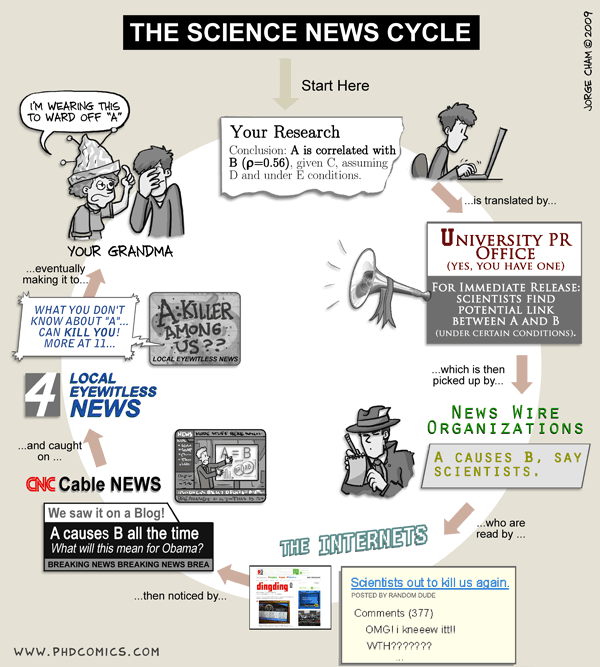
One reason scientific literacy is important

PhD Comics Science News Cycle

Two worthwhile reads from ActionBioscience.org: Why should you be scientifically literate? and Scientific literacy in the classroom.

Unemployment and Mental Health Tips

An article on CNN discusses the effects of long-term unemployment on mental health while profiling a software engineer and a photojournalist who haven’t succeeded in landing a job after months of searching. It’s a bleak picture. Unemployment increases the chances of depression and anxiety, and can lead to feelings of apathy, helplessness, anger, and profound self-doubt. It’s easy to get discouraged when you’re well-qualified and out of work in spite of your best efforts. After a while you might begin to wonder if your efforts are worthwhile.

Here are some general tips (several of them mentioned in the article) for staying mentally healthy while unemployed.

  • Take good care of yourself. This includes eating well, staying physically active, and getting enough sleep. Do your best not to leave medical or dental problems untended; a number of conditions when neglected become less easily treatable and more expensive to treat with time.
  • Connect with other people, not only for networking purposes but also socially (granted, the two overlap). Be sure to make time for people who generally help you feel positive, optimistic, and relaxed. Don’t stay cooped up all day at home.
  • Reserve some time for yourself each day or every week to be alone and unplugged from everything, free of other people’s immediate demands.
  • Consider returning to school or obtaining some kind of additional skills training, but only if you can strongly justify the investment of time and money and are clear about why you want to enroll in a given program (simply using it as an escape from “real life” is probably a bad idea). For any program you’re looking into, here are some questions to ask yourself:
    • Is it accredited?
    • What options are available to me for tuition reduction and other kinds of financial aid (that will hopefully not land me in decades of debt)?
    • Would I be offered opportunities to work while enrolled? What’s the track record for finding a job on completion of the program? Are there good career services in place that would offer me help?
    • Why is it that I want to get this degree/certification/training?
    • What do current and former students say about the program?
    • What are the alternatives to obtaining this particular degree or certification? What alternatives exist to the program I have in mind?
    • Does this program allow me to make use of previous educational or job experience? (e.g. transfer credits)?
    • Do I need to complete the whole program, or can taking a key class or two suffice for my purposes?
  • Learn for free online. Here are a couple of good lists of free online educational sites, where you can learn for the pleasure of it, to further your intellectual development, and to expand your job-relevant skills and training: The 100 Best (And Free) Online Learning Tools and 12 Dozen places to Educate Yourself Online for Free. Two of my favorite sites these days are The Khan Academy and Code Year.
  • Learn for free offline. Places where I’ve attended free lectures, discussions, and classes have included:
    • Public libraries
    • Museums
    • Local colleges and other educational institutions
    • Historical societies (and other societies of the sort)
    • Book stores
    • Public parks
    • Religious institutions
    • Healthcare institutions
    • Community centers

    These kinds of events are often advertised online and in local magazines and newspapers.

  • Volunteer. Opportunities for volunteering exist in practically every field. In addition to giving you the good feeling that comes from helping people and being engaged with the world, volunteering can strengthen or maintain your existing skills and train you in new ones, and also help you make new connections and obtain references.
  • Work on projects you’re passionate about. Along with giving you purpose and fulfillment, they might also make money for you or help your future employment prospects (including steady self-employment). Also keep an eye open for (legal) opportunities all around you, short-term and long-term. Maybe there’s a needed service you can offer people based on your skill set and experience.
  • Structure your day. In the absence of familiar routines each day can feel shapeless and devoid of direction and purpose. It’s easy for hours to pass unproductively in a blur of T.V. and web-surfing.

    You could have a detailed plan for what you want to do every hour, or just make a list of what you hope to accomplish every day, with the most important items given top priority; even if you rarely get to every single item on the list, you’ll at least address the most important ones.

    Your daytime plans should be as concrete as possible. For instance instead of saying, “I’ll look for work,” write down the specific actions you’ll take (the people you’ll contact, the applications you’ll fill out, the cover letter you’ll tweak, etc.).

    Also account for how you’ll be spending your time when you aren’t looking for work: obligations to family and friends, communal activities, various projects, chores around the house, personal time, sleep. The more disciplined you are, the easier it will be for your mind to stay sharp, focused and active; you’ll know what you need to do and work towards it with purpose.

  • Even if you’re feeling down, try not to brood. It’s useless, counter-productive and self-defeating. All those worries whirling around your head, all those negative remarks you’ve heard from others and beaten yourself up with lead nowhere. Find ways to cut off brooding if you start to sink into it – meditate, take a minute or two to just breathe, go for a walk, do some exercise, listen to some music, pray – whatever will keep you from rehashing and picking over the same negative thoughts. Focus your energies on concrete actions; stay open to various ideas.
  • Don’t take the situation personally, as a sign that there’s something fundamentally, irredeemably wrong with you. Others might try to make you feel it personally – they might gloat over your struggles or tell you that you aren’t trying hard enough or talk about how easy it was for so-and-so to land a job. Getting hit with these kinds of discouraging remarks can take a toll on your mental health and deplete you of the energy you need to stay productive.

    Your uncertain circumstances and lack of employment don’t make you a worthless person. Be open to suggestions and constructive criticism but don’t accept insults. Don’t fall into the trap of measuring yourself against everyone you meet to see how far you fall short, or how much better you are than them. Remember that we’re all human.

    People who undermine you in the guise of “helpful” or “motivating” remarks are to be avoided as much as possible; at the very least try to block out their remarks. Spend time with people who genuinely support you and stay engaged in activities that inspire you. Do what you can to stay hopeful and to keep working on yourself with an open and positive outlook.

Other resources:
A link from 2009 with content that’s still relevant today: 100 tips, tools, and resources to help you survive without a job.

Hope Now unemployment resources (part of a general site for homeowners, but the job-related links could apply people who don’t own a home).

Just found this Forbes article – 10 Things You Need to Do While You’re Unemployed (some of the advice overlaps with this post, and there are further suggestions about networking and resume-writing, along with an attitude of self-reliance and making opportunities for yourself).

I hope that at least some of these suggestions have been of use to you. Please feel free to comment with your own thoughts, advice, and experiences.

Aging, memory, and context

There are limitations to memory research studies conducted only in the lab, especially if they never include memory tasks and situations that are encountered in everyday life (in fact this is a limitation of lab studies investigating any cognitive process, not just memory).

For example, when researchers take into account how aging adults remember things in day-to-day life, they start to get a different picture of the difficulties people experience with memory as they get older:

When people are tested in the lab and have nothing to rely on but their own memories, young adults typically do better than older adults, she said.

Remarkably, when the same studies are conducted in real-world settings, older adults sometimes outperform young adults at things like remember appointments or when to take medicines.

Synaptic Sunday #3

This Sunday, some links on addiction and control:

1) The Fallacy of the Hijacked Brain

An op-ed from the NY Times:

A little logic is helpful here, since the “choice or disease” question rests on a false dilemma. This fallacy posits that only two options exist. Since there are only two options, they must be mutually exclusive. If we think, however, of addiction as involving both choice and disease, our outlook is likely to become more nuanced. For instance, the progression of many medical diseases is affected by the choices that individuals make.

2) Disease and Choice

One blogger’s response to the above op-ed.

The hijacked brain metaphor may be flawed, but it’s attempting to communicate that the addiction uses the addict’s own self-preservation instincts, desires and will to maintain addiction.

3) Addicts’ Brains May Be Wired At Birth For Less Self-Control

A study in Science finds that cocaine addicts have abnormalities in areas of the brain involved in self-control. And these abnormalities appear to predate any drug abuse.

Cocaine addicted people were studied alongside siblings who didn’t have a drug abuse history. What’s interesting is that the siblings also showed poorer self-control during the study’s task, and had atypical brain scan findings as well. So what led to one sibling abusing drugs, while the other didn’t? How do personal choices and environment come into play? Having a brain that might be more susceptible to poor impulse control or addictive behaviors doesn’t doom you to drug addiction. And, as in other studies, were there individuals whose results differed from the group as a whole? (e.g. a cocaine-addicted person who didn’t have the pre-existing abnormalities in the brain).

Attention smart people

Don’t be complacent:

And here’s the upsetting punch line: intelligence seems to make things worse. The scientists gave the students four measures of “cognitive sophistication.” As they report in the paper, all four of the measures showed positive correlations, “indicating that more cognitively sophisticated participants showed larger bias blind spots.”

What would a GSR bracelet do?

Months ago I read a short story, “Dead Space for the Unexpected,” by Geoff Ryman in a short fiction anthology Brave New Worlds: Dystopian Stories. In the story corporate managers are hooked up to and monitored by various technologies that measure not only their verbal and behavioral actions in the course of their job but also their physiological responses (things like heart rate and blood pressure and Galvanic Skin Response). It then gives them constantly updated scores on their calmness, effectiveness, and efficiency (down to millisecond-long reaction times) in the face of stressful situations, such as having to lay off an employee.

From what I remember, the monitoring technology didn’t make the main character a better manager. He was pretty obsessed about checking his scores and was anxious about them and about what would happen if he were to lose his edge as he gets older. I don’t remember if he or anyone else in the company ever came up with a better product or service (I’m not even sure what the company did). I do remember an atmosphere of excessive tension and competitiveness heightened by the technology, which, along with the scoring system, was abused during the course of the story. Nothing about the workplace seemed any better – no spirit of innovation and creativity for instance, or a genuine feeling of community and teamwork. No inspiring leadership.

The idea of monitoring technology probably sounded good on paper to the corporate head honchos who decided on it – not least because it gave them the means to more closely control and scrutinize their mid-level managers, who had little privacy – but what were its overall positive results? Just because a technology gives us a window into the responses of the brain and body doesn’t mean it’s worth the money or produces long-term benefit. It can instead be a waste of money that also distorts the human spirit.

I thought of this story after reading an article from a Washington Post blog on the hundreds of thousands of dollars of Gates Foundation grant money invested in the study of Galvanic Skin Response (GSR) bracelets that are meant to measure students’ engagement in the classroom.

GSR is a measure of physiological and psychological arousal involving the amount of moisture (sweat) on your skin. Ok, then. Many kinds of emotions can be picked up by GSR devices (which are used in lie-detection); if someone is afraid or angry or sexually aroused, the device shows an increase in arousal without telling you anything about the underlying cause.

How will the bracelet measure classroom engagement? Students could be excited about the lesson, sure, or they could be excited about the person sitting next to them, or worried about the test that’s coming up or afraid the teacher will call on them or interested in something they spotted out the window, or caught up in thoughts (exciting or unexciting) that have nothing to do with school.

Also assuming we could somehow isolate the underlying cause of arousal and pinpoint it to intellectual engagement (which is a complex state of mind in and of itself) does this tell us anything about how the students are learning? I can be engaged with a particular topic but still not understand it fully; I could find aspects of it puzzling or draw incorrect conclusions, excitedly thinking that I get it when I really don’t. Granted, the GSR bracelets would only be one measurement of student engagement, but what’s the point? If the bracelets tell the teacher that the students are fully attentive, the teacher would still have to make sure the wide-eyed interest translates into comprehension.

Other less expensive, less formal and more potent measures of attention and engagement exist – are students asking questions for instance? Are they asleep? Staring at the clock? Taking notes? Passing notes? Raising their hands? What does a bracelet add to all of this except to give schools a feeling of being cutting-edge and slick? (Reminds me of a number of fMRI studies I read through years ago that were poorly designed and didn’t measure what they claimed to but got published in peer-reviewed journals, one suspects, because fMRI was cutting-edge and a “window into the brain.”)

Then there’s the potential for abuse and gaming the system. From Diane Ravitch’s blog:

…a reader noted that the GSR bracelet was unable to distinguish between “electrodermal activity that grows higher during states such as excitement, attention or anxiety and lower during states such as boredom or relaxation.”

Thus a teacher might be highly effective if his students were in a statement of excitement or anxiety; and a teacher might be considered ineffective if her students were either bored or relaxed. The reader concluded, quite rightly, that the meter would be useless since a teacher might inspire anxiety by keeping students in constant fear and might look ineffective if students were silently reading a satisfying story.

So again, what would be the potential benefit of these bracelets? I’d like to see a copy of the grant proposal submitted by the researchers at Clemson University; how did they justify this study?

Synaptic Sunday #2

This Sunday, a few links on excessive anxiety.

1) Anxiety May Hinder Your Sense of Danger

The result implies that worriers are less aware of potential danger—challeng­ing the common theory that anxious individuals are hypervigilant. Frenkel be­lieves that worrywarts’ low sensitivity to external warning signs causes them to be startled frequently by the seemingly sudden appearance of threats, which leaves them in a state of chronic stress.

Further study is needed, but it’s an interesting example of how the brain might work against itself. High anxiety and stress are not meant to be chronic states of being, but reactions to specific situations.

2) Anxious Girls’ Brains Work Harder

A young woman could be intelligent, competent and knowledgeable, but if she has problems with anxiety her brain might not be functioning as efficiently as possible.

“Anxious girls’ brains have to work harder to perform tasks because they have distracting thoughts and worries,” Moser said. “As a result their brains are being kind of burned out by thinking so much, which might set them up for difficulties in school. We already know that anxious kids — and especially anxious girls — have a harder time in some academic subjects such as math.”

Initially the article points out that high brain activity was observed in the more anxious women when they detected an error in their performance on a task (had they not been able to tell when they were making a mistake, would the results have been different?) At least part of the problem could involve fixating on errors: worrying that you’ll repeat them, that you’re no good at this… and any other self-defeating thoughts. But I haven’t seen the original paper, just the write-up at the Sciencedaily link.

3) New Study Suggests Depression May Increase Vulnerability to Anxiety

Depressive disorders and anxiety disorders often go hand-in-hand. Why that is, is not 100% clear at this point. They might have similar neurological underpinnings and can both arise (and interact with each other) as a reaction to adverse circumstances in life. One kind of disorder might also make you more vulnerable to the other (as this study suggests, speculating about depression paving the way for anxiety). Anxiety could possibly make you more vulnerable to depression as well. If someone for example suffers from severe social anxiety, and in consequence experiences poor academic performance, difficulty securing a job, and personal relationships that are strained or nonexistent, depression could set in.

Don’t neglect any problems you have with anxiety. Even if you don’t have a formal diagnosis of an anxiety disorder, you might still be worrying too much and experiencing more stress than is good for you; excessive worrying can hinder cognitive performance and have other adverse effects on your mental activity and physical health. Finding healthy ways to manage anxiety is one of the best things you can do for yourself (here’s one set of suggestions, also making the important point that people with anxiety disorders often have more difficulty coping with life’s uncertainties; here’s another interesting discussion about worrying, with tips to cut down on it and further links to relaxation techniques).