The safety of negative criticism

In a class I took a few years ago, the professor assigned readings every week and instructed the students to come up with some comments or discussion questions in response. The readings were primarily research articles in psychology and neuroscience.

At one point the professor brought to our attention that most of the time our comments were negative and critical. “The researchers could’ve done XYZ but they didn’t” or “You can’t use an ANOVA for these data, can you?” or “They didn’t perfectly control for XYZ so their results are less conclusive.” These comments usually weren’t followed up on with alternate suggestions, so the professor would try to coax them out of people. “How would you have improved on the study?” she’d ask. But what’s more, she wanted a substantive discussion of the bigger picture questions. She started to demand more questions larger in scope and accompanied by people’s own ideas for experiments. The discussion had a different intensity then, more energetic and thought-provoking than when students just sat around picking at other people’s work.

Don’t get me wrong. It’s important to pick apart ideas and recognize a study’s limitations and flaws, whatever they happen to be: abuse of statistics, a poorly chosen subject population, a set of conclusions that’s too bold given the relatively weak results. That’s all a necessary part of critical thinking. Regardless of whether you’re a scientist or not you need to be able to evaluate people’s claims and see what merit they have.

But it’s also important to think in a more positive sense – generating ideas, asking questions, relating one topic to another and considering the implications of different findings. Fewer student comments referred to the strengths of any given study, only the weaknesses.

I remember at the time thinking of why negative remarks naturally dominated our discussions until the professor stepped in:

  • We were afraid to look stupid. If we offered our own ideas they could get shot down and maybe show the workings of an immature mind. What did we know? We didn’t want to take risks. Picking at other people’s mistakes protected us from the most part from criticism, and this was important because we worried too much about what others thought of us.
  • Some of us wanted to look like hotshots in a game of one-upmanship. It was less about the research, more about scoring points off of other people.
  • We were emulating certain professors. The one who ran the class wasn’t like this, but over the years I’ve known other professors who liked to devote their seminars to shredding the work of academic rivals in a mix of scholarly rigor and personal enmity (recently I watched a movie that explores this toxic mix).
  • We were on the receiving end of frequent critical evaluation, sometimes of a very negative kind, so we liked being able to dish it out. It gave us a feeling of power.
  • Making small focused negative remarks took less effort than also trying to think of solutions or come up with new ideas or questions to investigate. Granted, our critical thinking, even if it was mostly negative criticism, took more mental effort than just blindly accepting or rejecting something without justification; we did our homework. But for lack of time, training, knowledge or willingness to put in the effort, we stuck to picking things apart.

One reason I respected the professor who taught that class was her balanced approach to criticizing other people’s work. She looked for flaws, but also for possibilities. She encouraged debate and discussion but didn’t permit nasty remarks. The idea was that we were supposed to take risks, and think more widely and broadly than a purely negative approach would allow, while also being perceptive enough to delve into the nitty-gritty details of a research study and understand its limitations.

Staying purely negative would have been a safer option. In playing the part of ‘superior critic’ we wouldn’t have had to confront our fears, insecurities and weaknesses as much, or take as many risks. And the discussions wouldn’t have been nearly as productive and inspiring.
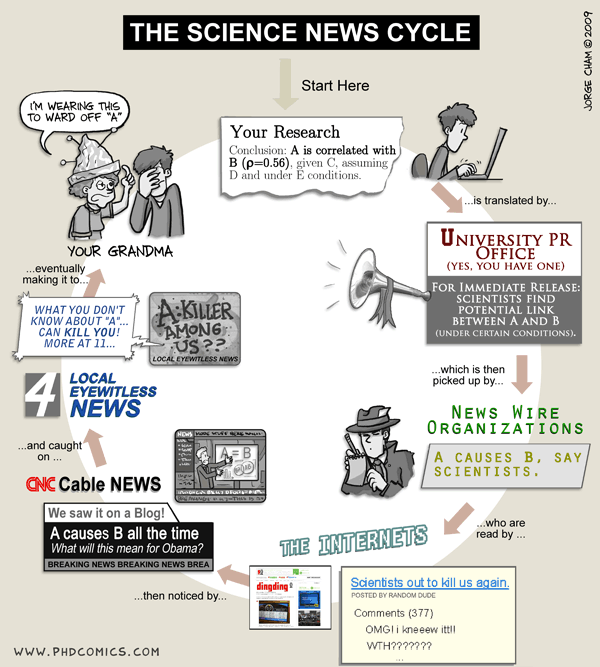
One reason scientific literacy is important

PhD Comics Science News Cycle

Two worthwhile reads from ActionBioscience.org: Why should you be scientifically literate? and Scientific literacy in the classroom.

Attention smart people

Don’t be complacent:

And here’s the upsetting punch line: intelligence seems to make things worse. The scientists gave the students four measures of “cognitive sophistication.” As they report in the paper, all four of the measures showed positive correlations, “indicating that more cognitively sophisticated participants showed larger bias blind spots.”

What would a GSR bracelet do?

Months ago I read a short story, “Dead Space for the Unexpected,” by Geoff Ryman in a short fiction anthology Brave New Worlds: Dystopian Stories. In the story corporate managers are hooked up to and monitored by various technologies that measure not only their verbal and behavioral actions in the course of their job but also their physiological responses (things like heart rate and blood pressure and Galvanic Skin Response). It then gives them constantly updated scores on their calmness, effectiveness, and efficiency (down to millisecond-long reaction times) in the face of stressful situations, such as having to lay off an employee.

From what I remember, the monitoring technology didn’t make the main character a better manager. He was pretty obsessed about checking his scores and was anxious about them and about what would happen if he were to lose his edge as he gets older. I don’t remember if he or anyone else in the company ever came up with a better product or service (I’m not even sure what the company did). I do remember an atmosphere of excessive tension and competitiveness heightened by the technology, which, along with the scoring system, was abused during the course of the story. Nothing about the workplace seemed any better – no spirit of innovation and creativity for instance, or a genuine feeling of community and teamwork. No inspiring leadership.

The idea of monitoring technology probably sounded good on paper to the corporate head honchos who decided on it – not least because it gave them the means to more closely control and scrutinize their mid-level managers, who had little privacy – but what were its overall positive results? Just because a technology gives us a window into the responses of the brain and body doesn’t mean it’s worth the money or produces long-term benefit. It can instead be a waste of money that also distorts the human spirit.

I thought of this story after reading an article from a Washington Post blog on the hundreds of thousands of dollars of Gates Foundation grant money invested in the study of Galvanic Skin Response (GSR) bracelets that are meant to measure students’ engagement in the classroom.

GSR is a measure of physiological and psychological arousal involving the amount of moisture (sweat) on your skin. Ok, then. Many kinds of emotions can be picked up by GSR devices (which are used in lie-detection); if someone is afraid or angry or sexually aroused, the device shows an increase in arousal without telling you anything about the underlying cause.

How will the bracelet measure classroom engagement? Students could be excited about the lesson, sure, or they could be excited about the person sitting next to them, or worried about the test that’s coming up or afraid the teacher will call on them or interested in something they spotted out the window, or caught up in thoughts (exciting or unexciting) that have nothing to do with school.

Also assuming we could somehow isolate the underlying cause of arousal and pinpoint it to intellectual engagement (which is a complex state of mind in and of itself) does this tell us anything about how the students are learning? I can be engaged with a particular topic but still not understand it fully; I could find aspects of it puzzling or draw incorrect conclusions, excitedly thinking that I get it when I really don’t. Granted, the GSR bracelets would only be one measurement of student engagement, but what’s the point? If the bracelets tell the teacher that the students are fully attentive, the teacher would still have to make sure the wide-eyed interest translates into comprehension.

Other less expensive, less formal and more potent measures of attention and engagement exist – are students asking questions for instance? Are they asleep? Staring at the clock? Taking notes? Passing notes? Raising their hands? What does a bracelet add to all of this except to give schools a feeling of being cutting-edge and slick? (Reminds me of a number of fMRI studies I read through years ago that were poorly designed and didn’t measure what they claimed to but got published in peer-reviewed journals, one suspects, because fMRI was cutting-edge and a “window into the brain.”)

Then there’s the potential for abuse and gaming the system. From Diane Ravitch’s blog:

…a reader noted that the GSR bracelet was unable to distinguish between “electrodermal activity that grows higher during states such as excitement, attention or anxiety and lower during states such as boredom or relaxation.”

Thus a teacher might be highly effective if his students were in a statement of excitement or anxiety; and a teacher might be considered ineffective if her students were either bored or relaxed. The reader concluded, quite rightly, that the meter would be useless since a teacher might inspire anxiety by keeping students in constant fear and might look ineffective if students were silently reading a satisfying story.

So again, what would be the potential benefit of these bracelets? I’d like to see a copy of the grant proposal submitted by the researchers at Clemson University; how did they justify this study?