Concerns About AI Bias Aren’t Just “PC-Ness”

People often need to frame things as a battle between two forces (“libs” vs. “conservatives,” or “SJWs” vs. “anti-SJWs”). Any concerns or opinions mentioned predominantly by one side will get automatically shot down by the other.

I’m seeing these kind of knee-jerk responses in conversations about algorithms trained to make predictions about individuals. Depending on where the algorithm is used, these predictions can affect anything from the health care you receive to whether you’re hired for a job.

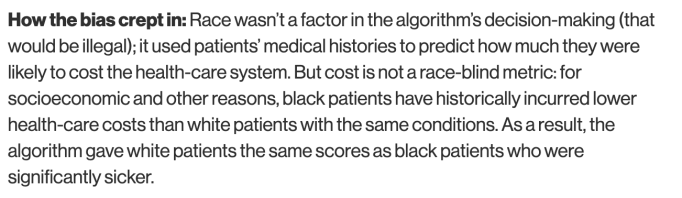
One example is a medical algorithm that was significantly more likely to recommend special health care programs for white patients than black patients who were equally sick. The factor that shaped the decision-making in this case wasn’t even race, at least not directly. From a recent MIT Technology Review article on this issue:
howbiascreptin

One of the remarks I regularly hear (and read) about this topic is that these algorithms are upsetting people because they reflect “facts not feelings” and that “facts don’t lie.” Ok, maybe facts don’t lie, but what do they actually reflect? What datasets are you training these algorithms on, and what do the data really tell you about people? (Not just groups of people, but individuals who are on the receiving end of these predictions.) The fact that members of one group may have historically been more likely to receive worse health care, on average, than members of another group doesn’t mean we need to perpetuate the problem.

The biases produced by these algorithms – biases which may be based on class, income, race, sex, or other dimensions – don’t necessarily reflect unchanging truths about human nature or social problems we can never address. So it’s disheartening to see people crow about how decisions based on algorithms are reflecting the “real truth” underneath the layers of PC-ness we’re festooned with as a society.

The medical algorithm mentioned in this post was examined, and the problem got addressed. In many other cases, we don’t know why algorithms are making predictions or decisions in certain ways. We don’t know what data they’ve been trained on, and companies are keeping quiet about it. There may be little accountability or option to appeal a decision. This is a critical issue to discuss, while hopefully minimizing the knee-jerk responses and the thought-terminating clichés (chants of “facts not feelings” from people who are also acting emotionally about this issue, though they don’t recognize their satisfaction or delight as feelings).

Excessive Negative Thoughts: Coping Strategies

This video from Psych2Go starts out discussing the terrible effects too much negative thinking may have on your health. After that onslaught of negative thoughts, it lays out several coping strategies (starting around two and half minutes in).

One important point that comes up during the suggestion to use distractions: these strategies aren’t meant for avoidance. Even when you distract yourself with a book or a movie, the goal isn’t to keep trying to escape from a problem in your life. The goal is to help yourself become less stressed so that you’re able to deal with the problem more effectively after you’ve become more calm.

Good luck! (I can tell you that the tip about paying attention to body language caught me off guard. Jaw unclenched, for the time being…)

New Ways to Fail Students

Just a few observations about New York City public schools:

  • There are schools where getting an ‘A’ is really easy, even without competence in a subject. Hand in the assignment, get a checkmark, and you’re good to go. Sometimes, students quickly realize they aren’t learning anything. Other times, realization comes from failing a state exam.
  • There are schools that shove students along from one grade to another, passing them so that they move ahead, and they arrive in high school struggling badly with math and literacy, including concepts and skills they ideally would have learned years earlier. They arrive without various kinds of basic knowledge and without good study habits.
  • The Department of Education inspires no confidence, although it does produce fuzzy, pleasant-sounding words about the supposed nobility of its aims.
  • It’s worth pointing out that there are excellent teachers and schools too. I’m just highlighting the fact that apathy, burnout, and soft expectations are major problems. Poor policies, ineffective educational methods, and large class sizes affect the general student population; however, students from low-socioeconomic status households feel the negative impact most strongly.
  • Kids whose parents can afford private tutors will hire tutors, or they’ll wind up sending their kids to private schools. Other kids will discover new ways of not learning math, reading, or writing, as the city implements various kinds of educational reforms that fail to address pervasive problems.

For now, that’s all I’m going to say on the subject of NYC schools. Until recent years, I didn’t realize just how much contempt there is for children.

Free, Free, Oh So Free

“Freedom of speech” is a phrase that gets thrown around a lot in the US. What limits does it come up against?

I’m not talking about free speech in terms of the first amendment alone. I’m also interested in what free speech means as a norm in various institutions and in civil society. And I’m not focusing on speech of low value (insults, childish name-calling, slurs); my concern is about the ability to hold a discussion on controversial topics, express a dissenting opinion, and ask an uncomfortable question, especially in forums that are meant for such conversations, such as a townhall meeting or a classroom.

This post is prompted by a book I’ve just read, The Lies They Tell by Tuvia Tenenbom, who took a six-month journey around the US, spoke to a variety of people, and reported his findings in what reads like a series of blog posts from the road.

There are observations he could have researched more or followed up on more deeply (though part of his approach was to let the various Americans he met explain things to him). I appreciated that he wasn’t trying to make anyone look stupid or ridiculous. He didn’t ask questions that were worded in a confusing way to trip people up. Usually he listened to an opinion and asked, “Why?” (What’s the basis for your belief? Why do you feel the way you do?). Or he pointed out the elephant in the room and observed people saying, “What elephant? No, that’s a housefly… maybe a swarm of houseflies… but not an elephant.”

Here are a few things that come up in the book, again and again:

Continue reading “Free, Free, Oh So Free”