Concerns About AI Bias Aren’t Just “PC-Ness”

People often need to frame things as a battle between two forces (“libs” vs. “conservatives,” or “SJWs” vs. “anti-SJWs”). Any concerns or opinions mentioned predominantly by one side will get automatically shot down by the other.

I’m seeing these kind of knee-jerk responses in conversations about algorithms trained to make predictions about individuals. Depending on where the algorithm is used, these predictions can affect anything from the health care you receive to whether you’re hired for a job.

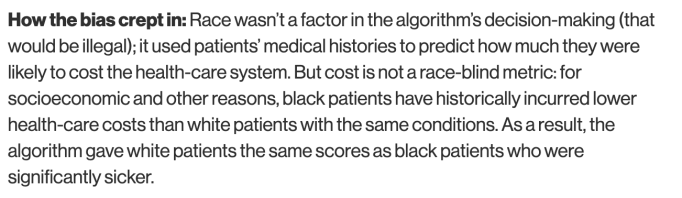
One example is a medical algorithm that was significantly more likely to recommend special health care programs for white patients than black patients who were equally sick. The factor that shaped the decision-making in this case wasn’t even race, at least not directly. From a recent MIT Technology Review article on this issue:

howbiascreptin

One of the remarks I regularly hear (and read) about this topic is that these algorithms are upsetting people because they reflect “facts not feelings” and that “facts don’t lie.” Ok, maybe facts don’t lie, but what do they actually reflect? What datasets are you training these algorithms on, and what do the data really tell you about people? (Not just groups of people, but individuals who are on the receiving end of these predictions.) The fact that members of one group may have historically been more likely to receive worse health care, on average, than members of another group doesn’t mean we need to perpetuate the problem.

The biases produced by these algorithms – biases which may be based on class, income, race, sex, or other dimensions – don’t necessarily reflect unchanging truths about human nature or social problems we can never address. So it’s disheartening to see people crow about how decisions based on algorithms are reflecting the “real truth” underneath the layers of PC-ness we’re festooned with as a society.

The medical algorithm mentioned in this post was examined, and the problem got addressed. In many other cases, we don’t know why algorithms are making predictions or decisions in certain ways. We don’t know what data they’ve been trained on, and companies are keeping quiet about it. There may be little accountability or option to appeal a decision. This is a critical issue to discuss, while hopefully minimizing the knee-jerk responses and the thought-terminating clichés (chants of “facts not feelings” from people who are also acting emotionally about this issue, though they don’t recognize their satisfaction or delight as feelings).

Excessive Negative Thoughts: Coping Strategies

This video from Psych2Go starts out discussing the terrible effects too much negative thinking may have on your health. After that onslaught of negative thoughts, it lays out several coping strategies (starting around two and half minutes in).

One important point that comes up during the suggestion to use distractions: these strategies aren’t meant for avoidance. Even when you distract yourself with a book or a movie, the goal isn’t to keep trying to escape from a problem in your life. The goal is to help yourself become less stressed so that you’re able to deal with the problem more effectively after you’ve become more calm.

Good luck! (I can tell you that the tip about paying attention to body language caught me off guard. Jaw unclenched, for the time being…)

New Ways to Fail Students

Just a few observations about New York City public schools:

  • There are schools where getting an ‘A’ is really easy, even without competence in a subject. Hand in the assignment, get a checkmark, and you’re good to go. Sometimes, students quickly realize they aren’t learning anything. Other times, realization comes from failing a state exam.
  • There are schools that shove students along from one grade to another, passing them so that they move ahead, and they arrive in high school struggling badly with math and literacy, including concepts and skills they ideally would have learned years earlier. They arrive without various kinds of basic knowledge and without good study habits.
  • The Department of Education inspires no confidence, although it does produce fuzzy, pleasant-sounding words about the supposed nobility of its aims.
  • It’s worth pointing out that there are excellent teachers and schools too. I’m just highlighting the fact that apathy, burnout, and soft expectations are major problems. Poor policies, ineffective educational methods, and large class sizes affect the general student population; however, students from low-socioeconomic status households feel the negative impact most strongly.
  • Kids whose parents can afford private tutors will hire tutors, or they’ll wind up sending their kids to private schools. Other kids will discover new ways of not learning math, reading, or writing, as the city implements various kinds of educational reforms that fail to address pervasive problems.

For now, that’s all I’m going to say on the subject of NYC schools. Until recent years, I didn’t realize just how much contempt there is for children.

Free, Free, Oh So Free

“Freedom of speech” is a phrase that gets thrown around a lot in the US. What limits does it come up against?

I’m not talking about free speech in terms of the first amendment alone. I’m also interested in what free speech means as a norm in various institutions and in civil society. And I’m not focusing on speech of low value (insults, childish name-calling, slurs); my concern is about the ability to hold a discussion on controversial topics, express a dissenting opinion, and ask an uncomfortable question, especially in forums that are meant for such conversations, such as a townhall meeting or a classroom.

This post is prompted by a book I’ve just read, The Lies They Tell by Tuvia Tenenbom, who took a six-month journey around the US, spoke to a variety of people, and reported his findings in what reads like a series of blog posts from the road.

There are observations he could have researched more or followed up on more deeply (though part of his approach was to let the various Americans he met explain things to him). I appreciated that he wasn’t trying to make anyone look stupid or ridiculous. He didn’t ask questions that were worded in a confusing way to trip people up. Usually he listened to an opinion and asked, “Why?” (What’s the basis for your belief? Why do you feel the way you do?). Or he pointed out the elephant in the room and observed people saying, “What elephant? No, that’s a housefly… maybe a swarm of houseflies… but not an elephant.”

Here are a few things that come up in the book, again and again:

Continue reading “Free, Free, Oh So Free”

A Reminder About Humility in Judgment

A couple of days ago, I was thinking about something that often happens online (and offline too) – when you have a conversation with someone, and they aren’t really speaking to you; they’re speaking to their misconception of you.

In the conversation, you feel like an image has coalesced next to you. It vaguely resembles you, and it’s made up of the other person’s mistaken assumptions about your motives, beliefs, hobbies, etc.

To varying degrees, I think we all have a tendency to do this to other people. We fly to quick judgments about them based on stereotypes or based on our own fears or interactions with superficially similar people. Some people do this maliciously; they deliberately create cruel and damaging misconceptions that they try to force as truth during a conversation.

I remembered something I wrote a couple of years ago around this time of year – the Jewish High Holidays, Rosh Hashanah and Yom Kippur. It was a piece on humility in judgment. Humility isn’t a fashionable characteristic, especially because it’s often confused with ‘humiliation’ or ‘abject lowliness.’ In truth, it’s an aid to clearer thinking and integrity.

From that piece:

Humility opens up space for self-awareness, thoughtfulness, and doubt. You make a judgment whenever necessary, while remaining conscious of the fact that you may have erred or acted on incomplete knowledge. You acknowledge the possibility that you’ll need to revise your judgment in the future.

Forming a judgment with humility isn’t the same thing as assuming a non-judgmental pose or deciding that you aren’t capable of judging at all. Rather than kill your ability to judge, humility refines it. You’re less apt to rely on snap judgments and more likely to assess a situation thoughtfully, with a better sense of your limitations.

This isn’t easy. Humility is an admission that you’re living with uncertainty. It reminds you of the limits of your knowledge and powers of thought.

Let’s keep aiming for genuine humility in judgment, in conversation, and in thought. You can still speak with conviction but without overestimating how much (or how well) you know or understand.

Understanding the Difference Between Feeling and Acting

Have you noticed how often people confuse a feeling with how they act on that feeling?

For example, when parents beat their kids, and you ask them why, they might say, “I was angry.”

But that isn’t an answer. It’s a description of an emotional state. An answer would be, “I chose to act on my anger by beating my kid.” It was one of multiple options for how they could have handled their anger. “I was angry” is not an answer. It’s not an excuse for inflicting harm.

Even if the action isn’t something as severe as a beating, it can still be a damaging choice. “Screaming at,” for instance, or “putting down.”

Another example is how people use desire as an excuse for rape or sexual assault. As if there’s only one way to act on feelings of sexual desire. Like you’re on autopilot between the first stirring of desire and the violation of another person.

Managing your emotions and exercising self-control are a critical part of being a mature person. Ideally, you begin to learn useful lessons as a kid for how to understand feelings and figure out ways to deal with them that don’t involve harming other people or yourself.

Many people unfortunately don’t learn these lessons growing up, or they learn them inconsistently and poorly. Regardless, as an adult, it’s important to work towards greater maturity. You need to distinguish between emotions and actions and build up habits of thought and behavior that will help you avoid destructive choices.

I’m not saying this is easy to do. Sometimes, the distance between an emotion and an action can seem incredibly small, even nonexistent. People are especially vulnerable in certain areas, like sex or relationships more generally, food and drink, acquisitiveness, various fears. You’re influenced by insecurities, beliefs about what you’re entitled to, ingrained behaviors that kick in thoughtlessly, and other deep-seated issues that need to be examined and addressed. You also can’t be complacent about the self-control you’ve achieved so far.

In day-to-day life, the hardest struggles often involve the power of feelings and the temptation to take the path of least resistance to them, to surrender to them fully. But that isn’t the path of maturity and wisdom.

Beware of Forced Binaries

One of the most annoying types of arguments to come across (for me, anyway) is the one involving forced binaries. A complex issue gets reduced to two possibilities – like nature or nurture, or the question of whether rape is about sex or power – and these two possibilities get treated as if they’re mutually exclusive. Pick one, and make your stand.

Whether you’re having a classroom discussion or arguing with someone online, here are three steps to take when you’re confronted by a forced binary:

Ask yourself what each choice really means. In the context of the discussion, how are people defining ‘power,’ ‘nature,’ or any other word? Sometimes, you get a disagreement because people are thinking about the same concept in fairly different ways. If you clarify definitions, you may discover a greater degree of agreement than you expected.

Ask yourself if these choices are really mutually exclusive. Just start with, “Why not both?” and think about it from there. The two possibilities you’re forced to choose between may be interacting with each other in interesting ways.

Ask yourself if there are other factors at play. Forced binaries are simpler and tidier. They’re also a great way to create two clear sides and pit people against each other. But the issues you’re discussing often have more complexity.

Good luck!

Recommended Reading: The Tyranny of Opinion

I recently read a book that would have been relevant before widespread Internet use and the advent of social media, but makes for even more urgent reading now.
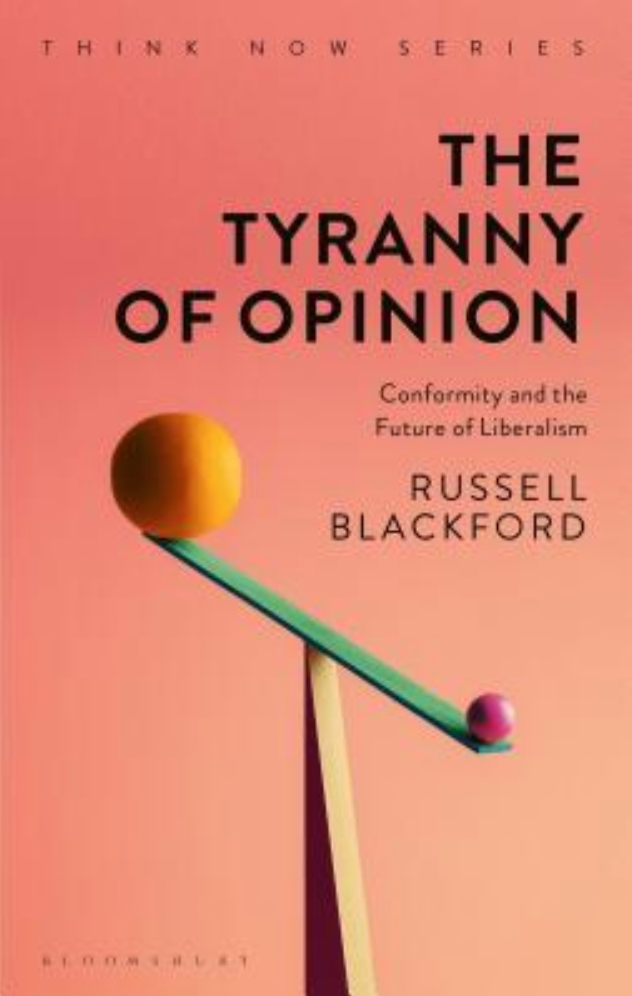
TyrannyofOpinion

The Tyranny of Opinion by Russell Blackford discusses threats to freedom of speech beyond government censorship. Blackford focuses on coercion and conformity imposed by other powerful institutions and forces in society, including online mobs that foment outrage against offending individuals, often with abuse, slander, harassment, and serious threats, such as loss of employment.

I appreciate the book’s thoughtful discussion of free speech, including the question of what constitutes harmful expression, and how people have different ideas of what’s harmful. For example, most would agree that issuing death threats or inciting a mob to attack shouldn’t be counted as free speech. However, people may want to suppress speech that appears to undermine a set of beliefs they hold dear. Harm as a concept can get stretched from the threat of literal violence to feelings of upset, anger, or offense. How do we best determine the standards of harm for our society?

The book serves as a reminder of what free speech is meant to protect and why it’s important to uphold it as a general principle (and not limit it to a question of what the government permits). Are the following important to you?

  • The ability to engage in free inquiry, including questioning ideas and conducting investigations into different topics.
  • The ability to discuss various issues, including the pros and cons of public policies.
  • The ability to write, paint, and create other art. (Of course there have been controversies, including questions about whether a piece has artistic merit or is mere obscenity. But do you generally prefer to critique an artistic work, or do you lean more towards bans, threats, and harassment of authors and artists?)

There are challenges to upholding free speech, not least because people have a strong tendency to be tribal about it. (Even people who consider themselves free speech proponents are prone to tribalism; they’ll gladly defend one of their own, but not a political opponent.)

People are also prone to exercising coercion, imposing certain types of thought and speech on anyone who doesn’t conform. The book provides multiple examples of the way “offenders” are met not with well-reasoned critiques but with exaggeration, dishonesty, displays of moral outrage, and threats against livelihood, reputation, and physical safety. With social media, it’s easy to instantly whip up large numbers of people from all over to descend on an offending individual, and no facts or well-developed arguments are necessary.

Instead of reasoned arguments, people often rely on personal attacks and ascribe all kinds of evil intentions to someone who steps out of bounds. Discussing a 1994 article by Glenn Loury, Blackford writes:

Within a milieu of political conformity, anyone who speaks out on a particular topic in a particular manner will be judged personally. Meaning will be read into her manner of expression, and her arguments may never be examined on their merits. Questions about her data and her reasoning may well be set aside, and instead she will be assessed as someone who was willing to speak in that way, at that time, on that topic. This may reveal her as an apostate from her group, especially if its true believers are hiding whatever misgivings they have about the local orthodoxy. A likely consequence is that a group’s moderates and internal dissenters will be driven out of conversations, or at least be forced to keep silent about their moderate and dissenting opinions.

What happens when people are afraid to speak, express doubt, or question a group in any way? Along with festering resentment, stagnation sets in. Far fewer original thoughts, interesting proposals, or important questions get introduced. People’s capacity for critical thinking weakens, and they struggle more with how to construct a strong argument or evaluate evidence. (What need is there for critical thinking when you can engage in knee-jerk outrage?) There’s also more dishonesty, distortions, and misconceptions. For example, when non-conforming thoughts are severely curbed in a particular environment (such as a university), people might assume that the established, acceptable opinion on a certain topic is more widely held than it actually is, because no one is speaking out in disagreement or calling for greater nuance.

Towards the end of the book, Blackford offers suggestions for how to combat forced conformity and promote well-reasoned discussions and inquiry. Examples include recognizing propaganda techniques, resisting the knee-jerk impulse to join social media mobs, assessing other people’s words and intentions in as fair-minded a way as possible, pushing for changes in various organizations in terms of their speech codes or the reasons for which they fire someone, and facing down an outrage-fueled mob without caving in to irrational demands or abuse.

Another book I read recently, The Coddling of the American Mind, overlaps in some of its topics with The Tyranny of Opinion and also offers suggestions at the end for “wiser kids,” “wiser universities,” and “wiser societies,” including ways to protect physical safety and dignity while engaging in more robust discussions, self-reflection, and a principled stand against mobs.

I want to be optimistic, and I do see more people sharing concerns about conformity and the suppression of free speech and inquiry in ways that don’t involve government censorship. But what are the incentives for greater numbers of people to more consistently resist suppression, conformity, and an overly broad definition of harm?

Outrage and tribalism are powerful and attractive. The self-righteous thrill, the malicious glee, or the power trip of fomenting or joining a mob appeals to many. Engaging in more critical thinking and self-reflection is difficult, and the rewards aren’t usually immediate. Evaluating evidence, waiting for more evidence, withholding a knee-jerk opinion, making the effort to truly understand someone with a different political point-of-view, and conveying another person’s point-of-view honestly – all of that takes mental effort and a commitment of character.

You can say that one of the rewards is a strengthening of your integrity and self-respect. But to what extent do people care enough or even associate those qualities with the ability to sustain a civil, honest discussion? It’s also much less risky to keep your head down, especially if you aren’t wealthy, well-connected, or powerful. A major pushback against mob mentality and excessive restrictions on speech will need to come from thoughtful, influential individuals and from large numbers of people who support them – people who don’t agree with each other on all topics or share all of the same beliefs.

Here’s another excerpt from the book. It can serve as a call to action, pushing for a return to traditionally liberal values, which are necessary to maintain a certain kind of society. (If this kind of society is sufficiently important to us, we’ll try to keep those values alive.)

… principles such as secular government, free inquiry and discussion, and the rule of law; values such as individuality, spontaneity, and original thinking – have wider cultural resonance if only we take the trouble to explain and advocate them. When we override these principles and values with supercharged anxieties about identity and offence, we throw away what made liberalism attractive in the first place.”
Three Parenting Styles to Avoid

Is permissiveness the main problem with parenting nowadays? Permissive in the sense that kids get away with too much, run wild, fail to stay off people’s lawn, that kind of thing.

Based on what I’ve observed, permissiveness isn’t the sole problem, or even one of the most important ones. A lot of dysfunctional parenting involves excessive control or unrealistic expectations (like, “You will never fail, you will always be happy, you will always be my friend, you will be the answer to all my problems” etc.).

The three dysfunctional parenting styles I’m bringing up in this post are:

The Helicopter Parent

Helicopter parents hover over their kid in a stifling, unrelenting way that’s inappropriate for the kid’s age and abilities. They micromanage many or all aspects of their kid’s life and keep the kid from confronting reasonable challenges.

After thwarting their kid’s independence, helicopter parents say, “Because my kid can’t do things on their own, I need to swoop in and save them.” Excessive dependence is the result.

Kids of helicopter parents have a difficult time learning how to do things on their own, deal with setbacks, and work out interpersonal problems. They’re more likely to feel helpless and think of themselves as ineffective across different situations. Anxiety and depression can easily take root in them.

The Buddy Parent

There’s nothing wrong with parents and kids being friendly with each other or having fun together. But there are parents who act as if they’re friends with their kids the way a classmate or sibling would be.

They don’t tend to set rules, define boundaries, or act as a reasonable authority figure. (Far from consistently, anyway.) They want to be liked at all times. Some of them talk to their kids as they would to an adult friend and share their personal problems inappropriately. (They may in some ways wish to be kids themselves.)

In reference to the issue mentioned at the start of the post, this kind of parent is generally too permissive. (However, wanting to be their kid’s best buddy isn’t the only reason parents become overly lenient. Sometimes, parents aren’t particularly interested in their kids, and their permissiveness comes from being detached and neglectful.)

The Sculptor Parent

To these parents, the kid isn’t a person but a project. The kid can be shaped into a trophy, something the parent will be proud to display in-person and on social media. The kid can be crammed into the mold of an athlete, straight-A student, artist, scientist, beauty pageant contestant, or whatever else the parent needs them to be.

Parents who get competitive with each other, who strongly need approval from other people, or who want to live out personal dreams and hopes through their child are all susceptible to becoming sculptors. Another scenario is when parents can’t stand certain qualities in the child – usually qualities that the parents hate in themselves. They lack the self-awareness to deal with their emotions in a mature way, so instead they apply the chisel to the marble or squeeze and squeeze the clay, as if their kid can be made into anything.

This parenting style hampers the child’s ability to develop their own personality and explore their own interests. It teaches kids that they aren’t loved for themselves but for how they perform to expectations. Kids raised like this can wind up suffering burnout, depression, and an intense fear of failure, a sense that if they aren’t successful or given approval, they won’t be worth anything.

What Does Dysfunctional Parenting Typically Boil Down To?

There are other dysfunctional (and abusive) patterns of behavior that I haven’t covered here. But a key characteristic of dysfunctional parenting, regardless of the form it takes, is the parent’s inability to genuinely see their own child. They fail to treat the child as a distinct individual.

Parents wind up using the child to serve some psychological need. They may need the child to be a scapegoat, a vessel for the parent’s dreams, the parent v2.0 with certain bugs fixed, a clingy dependent who’ll never walk away, a best friend who’ll always like them, an uncomplaining servant, or whatever else.

Parents will often be controlled by this psychological need. They won’t be aware of it, at least not fully, and they’ll resist thinking deeply about their own actions, because the need is painful and powerful. Parents usually find ways of rationalizing their behavior (“I’m keeping them safe; I want them to succeed”). But these parenting styles aren’t about safety, success, or happiness. They serve the parent psychologically while undermining the kid.

What Affects the Quality of Your Thinking? (It’s Not Just Intelligence)

The quality of your thinking depends so much on your character. The company you keep is also important.

It’s not that intelligence doesn’t play a role. It’s just insufficient. Intelligent people don’t necessarily think with depth, either generally or in response to specific topics. There’s no guarantee that they’ll ever investigate their own opinions or question their own conclusions with any seriousness.

They may use their mental agility to deflect substantive pieces of evidence, anything that contradicts their view of “how things are.” These deflections can be harmful, shutting down important questions and preventing a much-needed discussion.

Intelligent people may be clever at crafting rationalizations or arguments that seem well-structured. Many times, they don’t question whether they’re behaving with integrity; it’s enough that other “right-minded” people are expressing the same thoughts. They may prioritize “owning” someone in an argument over learning anything. Or they use their intelligence mostly for snark and viciousness.

An intelligent mind may be a lazy mind. It may be narrow or given to exceptional dishonesty. (Context matters too. An individual can display in-depth thinking in one area of life while remaining superficial or dishonest in other areas – and either not recognizing the superficiality or not being troubled by it, because it doesn’t cost them social approval.)

Continue reading “What Affects the Quality of Your Thinking? (It’s Not Just Intelligence)”